


When Should an LLC Elect S-Corp Status to Save on Taxes?
Tax Strategy for Growing LLCs
As a small business owner, reaching $50,000 to $100,000+ in annual net profit is a major milestone. But when tax season rolls around, many LLC owners face a jarring realization: they are paying significantly more in taxes than corporate CEOs.
If your business is structured as a standard single-member LLC or sole proprietorship, you aren't just paying regular federal and state income tax—you are also paying 15.3% self-employment tax on 100% of your net earnings.
Fortunately, the tax code provides a legal, IRS-approved mechanism to reduce this burden: the S-Corporation tax election (IRS Form 2553).
How the S-Corp Tax "Hack" Works
By default, the IRS views a single-member LLC as a "disregarded entity." Every dollar of net profit flows directly to your personal tax return and is slapped with the 15.3% self-employment tax (which covers Medicare and Social Security).
When you elect S-Corporation status for tax purposes, your LLC's legal structure doesn't change, but how the IRS taxes your income changes completely.
Instead of treating all net income as self-employment profit, an S-Corp allows you to divide your earnings into two distinct buckets:
W-2 Owner Salary: You pay yourself a "reasonable salary" through formal payroll. This portion is subject to standard 15.3% payroll taxes.
Shareholder Distributions: The remaining net profit is paid out to you as a business distribution. Distributions are 100% exempt from the 15.3% self-employment tax.
The Real Math: How Much Can You Save?
Let’s compare a standard single-member LLC against an S-Corp election for a business making $100,000 in net profit:
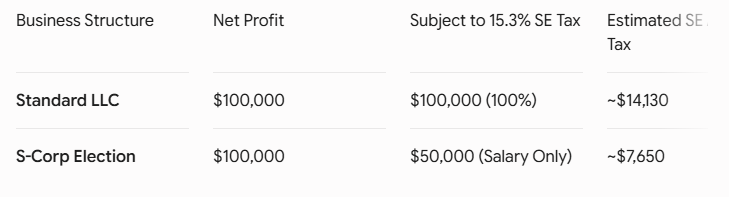
In this scenario, electing S-Corp status puts over $6,000 back into your bank account every single year.
When Is the Right Time to Make the Switch?
An S-Corp election isn't a one-size-fits-all solution. Because S-Corps require formal W-2 payroll, separate corporate tax filings (Form 1120-S), and strict IRS compliance, there are administrative costs involved.
The Golden Rule: Making the election typically makes financial sense once your business generates at least $40,000 to $50,000 in annual net profit (after operating expenses) and that income is consistent.
Next Steps for Your Business
If your business is hitting these numbers and you're still paying taxes as a standard LLC, you are likely leaving thousands of dollars on the table every year.
Want to calculate your exact S-Corp savings? Contact GP Accounting, LLC today to schedule a 15-minute S-Corp tax evaluation and learn how to implement a defensible reasonable salary strategy.